
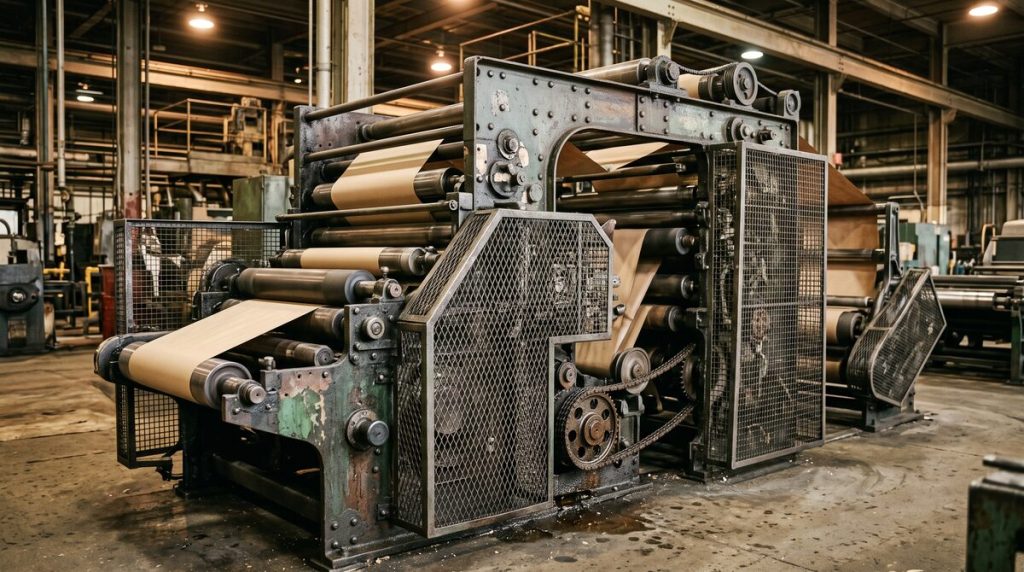
A converting line can run for decades on a frame that is still true and bearings that are still serviceable, and then stop because one drive card is no longer manufactured. The machine is not worn out. The supply chain behind a single component has moved on. That is parts obsolescence, and on an installed converting line it usually arrives long before the machine itself is finished.
The size of the installed base is easy to underestimate. Federal Reserve figures released on 18 August 2026 put capacity utilization for manufacturing at 76.0 percent in July 2026. That rate sits 2.2 percentage points below its long-run 1972–2025 average. The paper industry operated at 78.0 percent against a long-run average of 86.5 percent. Output in these sectors comes off equipment that is already on the floor. Every one of those machines carries a parts list, and parts lists age faster than steel.
Three Kinds of Obsolescence, Not One
Treating obsolescence as a single problem is what makes it expensive. It arrives in three distinct forms, and each one has a different answer.
Mechanical obsolescence covers gears, shafts, cams, rolls, and fabricated components. These parts are rarely unavailable in any real sense. They were made from a drawing once, so they can be made from a drawing again. The obstacle is usually documentation rather than manufacturing capability. A shaft can be reproduced from a sound original by measurement, though the tolerances and material have to be established rather than assumed.
Electrical and controls obsolescence moves on a much shorter clock. A machine frame is designed for a working life measured in decades, while the drives, PLCs, sensors, and human-machine interfaces bolted to it follow product cycles measured in years. A control platform can reach end-of-support while the machine it commands is barely halfway through its service life. The mismatch is structural rather than accidental, which is why it catches so many plants by surprise.
Documentation obsolescence is the quietest of the three. Drawings go missing, an undocumented modification is made during a night shift, and the machine on the floor stops matching the machine in the manual. Once that gap opens, every later repair starts with reverse engineering.
Why Converting Equipment Is Particularly Exposed
Converting machinery tends to be built in small numbers for a specific web, a specific substrate, and a specific rate. A winder built for a nonwovens producer is not a catalogue item with thousands of identical units in the field. Because the population of any given model is small, component suppliers have little reason to keep tooling alive for it. The original build documentation carries more weight as a result.
On top of that, converting lines are often the constraint in a plant. When a slitter or rewinder stops, the unwind upstream and the packaging downstream stop with it. That is why the parts question deserves attention before a component fails rather than after.
There is a second exposure worth naming. Converting equipment is frequently modified in service, because substrates change and customers ask for widths and formats the original build never contemplated. Each modification is sensible on its own terms. Taken together, they move the machine further from its documented configuration, so the parts list that shipped with it describes something that no longer exists.
Mapping Obsolescence Before It Bites
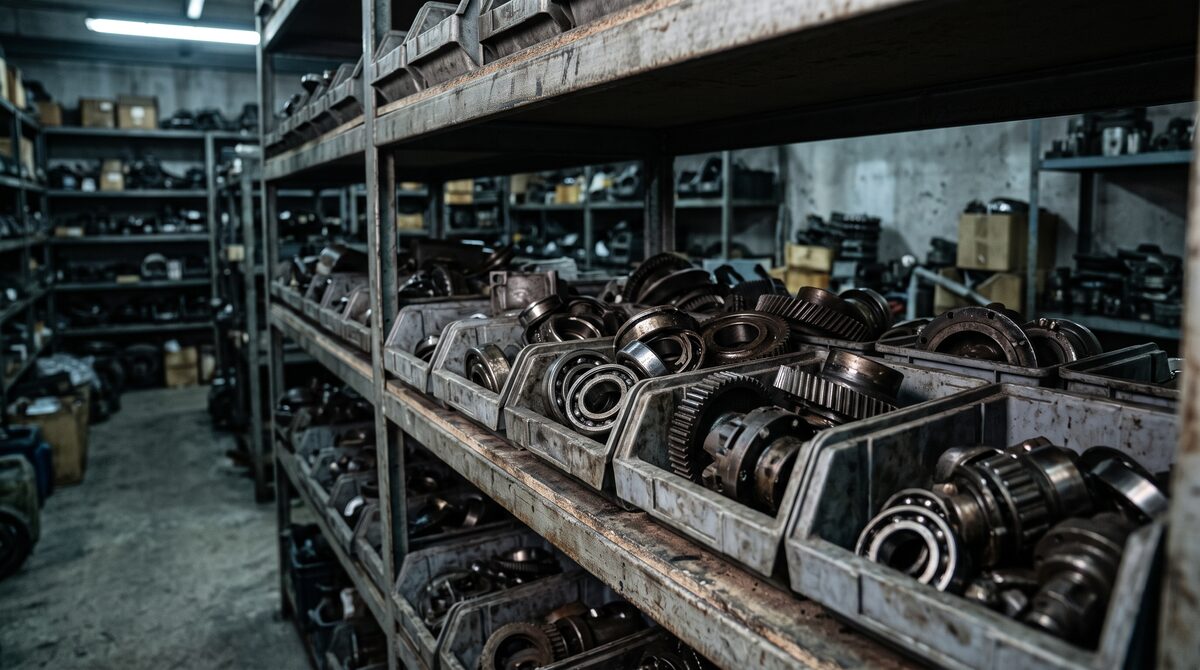
The practical starting point is an inventory of what is actually installed. That means walking the line and recording control platforms, drive models, sensor types, and the parts that carry known wear. Working out which of those items are still supported by their original manufacturer separates the genuinely urgent from the merely old. Age alone is a poor signal, since a thirty-year-old mechanical assembly may be entirely reproducible while a twelve-year-old controller may not be. Deciding what to stock follows directly from that map, which is covered in more detail in how converting plants decide which spare parts to stock.
Once a component is confirmed obsolete, there are usually four routes: locate remaining stock, manufacture a replacement from drawings or by measurement, substitute a current-production equivalent, or upgrade the subsystem the component belongs to. The right route depends on how many other parts of the machine sit on the same obsolete platform. When a single sensor is dead, a substitution is proportionate. When the whole control architecture is out of support, a subsystem upgrade is often the more coherent answer, and at that point the question shifts toward whether to rebuild the machine or replace it.
Smaller manufacturers working through this without in-house engineering support have a public option. The NIST Manufacturing Extension Partnership runs centers in all fifty states and Puerto Rico, providing technical assistance to small and mid-sized manufacturers.
Elsner Engineering: Converting Machinery Support in Hanover, PA
Elsner Engineering has designed and built custom machinery in Hanover, Pennsylvania since 1934, with engineering, machining, and assembly in one 112,000 square foot facility. Fifty people work in that building, and the quality management system is audited against ISO 9001:2015.
Our Services Include:
- Commercial Series Machinery — Support, spare parts, and field service for converting equipment already in production
- Retrofit — Modern controls fitted to legacy equipment that is still worth running
Working through an obsolete component on a converting line?
about the machine, the process, and the constraint.
Converting equipment designed and built in Hanover serves nonwovens, filtration, wipes, and rolled products. Work on machines already in service runs alongside new builds, so the drawings, the machining capability, and the assembly floor all sit in one place.
Frequently Asked Questions About Converting Equipment Parts Obsolescence
01What does it mean when a converting machine part is obsolete?
An obsolete part is one the original manufacturer no longer produces or supports. The machine itself may be sound. Obsolescence describes the supply position of a component rather than the condition of the equipment, so an obsolete part often sits inside a converting line that still runs its process well.
02How do I find a replacement for a discontinued machine component?
Four routes exist. Remaining stock can sometimes be located, a mechanical part can be manufactured from drawings or from measurement of a sound original, a current-production equivalent can be substituted, or the whole subsystem can be upgraded. Which route fits depends on what else shares that platform.
03Why do controls become obsolete before the machine does?
A converting machine frame is designed around a working life measured in decades, while drives, PLCs, sensors, and operator interfaces follow commercial product cycles measured in years. That difference in timescale means a control platform can reach end-of-support while the machinery around it remains entirely serviceable.
04Can a part be made without the original drawings?
Often yes, provided a sound original or a usable remnant exists to measure. Reverse engineering establishes dimensions, tolerances, material, and any heat treatment. The work is more involved than machining from an existing drawing, because the specification has to be determined rather than read.
05How often should a converting line be reviewed for obsolete parts?
An annual review against the current machine inventory suits most plants. Reviewing more often makes sense after a control upgrade, a substrate change, or any modification that moves the machine away from its documented configuration. Supplier end-of-support notices are worth capturing whenever they arrive.
Works Cited
- Board of Governors of the Federal Reserve System. “Industrial Production and Capacity Utilization — G.17.” 18 Aug. 2026, www.federalreserve.gov/releases/g17/current/g17.txt. Accessed 24 Aug. 2026.
- National Institute of Standards and Technology. “Manufacturing Extension Partnership (MEP).” U.S. Department of Commerce, www.nist.gov/mep. Accessed 24 Aug. 2026.