
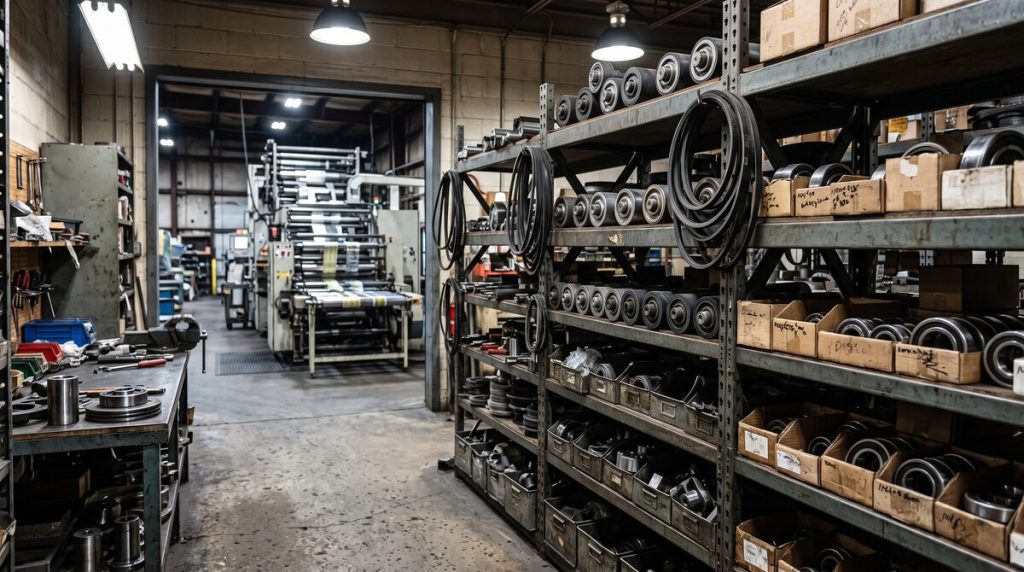
Every converting plant holds spare parts, and most hold the wrong ones. Shelves fill with items that were easy to order rather than items that would actually hold up a line, while the components that carry real schedule risk sit on nobody’s list. A critical spare parts inventory is built the other way around, starting from consequence rather than from catalogue.
The labour picture is part of why this matters more than it once did. The Bureau of Labor Statistics reports that industrial machinery mechanics, machinery maintenance workers, and millwrights held about 538,300 jobs in 2024, with employment projected to grow 13 percent through 2034 and roughly 54,200 openings expected each year over the decade. Much of that opening volume comes from workers retiring or moving on. As experienced maintenance staff leave, the informal knowledge of which part matters tends to leave with them, so writing it down becomes part of the job.
Criticality Is Not the Same as Cost
The instinct is to stock what is expensive. A more useful test asks two questions about each component: what happens to production when this fails, and how long does a replacement take to obtain.
A part that stops the line and takes twelve weeks to source belongs on the shelf whatever it costs. A part that stops the line but is available overnight from a distributor probably does not. An inexpensive proximity sensor on a critical interlock can outrank a costly component that has a ready substitute. Sorting the list this way usually shrinks it, because most of what sits in a stores area fails neither test.
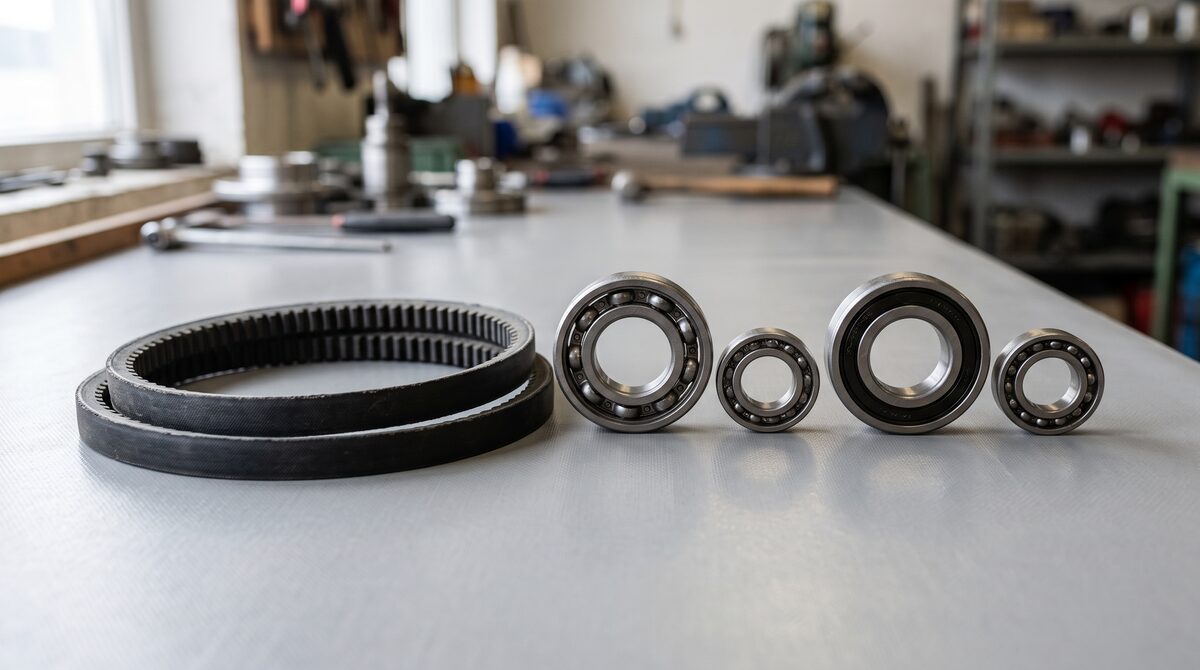
The same logic applies in reverse to parts nobody thinks of as spares at all. Drive belts, couplings, and pneumatic fittings rarely appear on a formal list, yet a converting line can sit idle over one of them if the size is unusual.
The Four Groups Worth Separating
Wear items are the parts a converting line consumes by design — slitting blades, rolls, belts, nip covers, and bearings. These are predictable. Consumption rates can be tracked against running hours and reordered on a cycle rather than in response to a failure.
Long-lead components are the schedule risk. Custom-machined shafts, purpose-built rolls, and fabricated assemblies are made to order, so the lead time is the lead time whether or not the line is down. Holding one of these is a decision about exposure rather than about stores housekeeping.
Obsolete-platform components are the group most often missed. When a drive family or controller has reached end-of-support, remaining stock is finite and is not being replenished. These parts are covered in more depth in the discussion of how parts obsolescence develops on converting lines.
Commodity items — standard fasteners, common bearings, general electrical components — need only enough on hand to cover a normal week.
Write the Procedure With the Part
A shelved spare is only useful if someone can fit it. Machine-specific service procedures are also a regulatory matter, because OSHA’s standard on the control of hazardous energy sets out procedures for controlling hazardous energy during the servicing and maintenance of machines, and requires employers to train each worker to follow the applicable energy control procedures.
Building that documentation alongside the parts list means the change can be carried out safely by whoever is available rather than only by the person who has done it before. Recording the part number, the drawing, the supplier, the lead time, and the removal sequence in one place converts a stores area into something a shift can work from at three in the morning.
Storage conditions belong in the same record. Elastomer components age on the shelf, bearings need their packaging intact, and electronic boards are sensitive to damp and to static. A spare that fails on installation because of how it was stored costs the same production time as no spare at all.
Reviewing the List
A critical spares list goes stale. Machines get modified, suppliers discontinue lines, and production rates change what counts as critical. An annual review against the current machine inventory keeps it honest. Pairing that review with the maintenance log is what turns it from an inventory exercise into a picture of where the line is actually vulnerable.
When that review keeps returning the same machine with a lengthening list of unsupported components, the underlying question is no longer about spares — it is whether that machine should be rebuilt or replaced.
Elsner Engineering: Converting Machinery Support in Hanover, PA
Elsner Engineering has designed and built custom machinery in Hanover, Pennsylvania since 1934, with engineering, machining, and assembly in one 112,000 square foot facility. Fifty people work in that building, and the quality management system is audited against ISO 9001:2015.
Our Services Include:
- Commercial Series Machinery — Support, spare parts, and field service for converting equipment already in production
- Machining — CNC milling, turning, and 5-axis work for components made from a drawing or from measurement
Need a component that is no longer catalogued?
about the part, the machine, and the material.
Components can be produced from existing drawings or from measurement of a sound original, using CNC milling, turning, 5-axis machining, EDM, and grinding on site. Prototype quantities and production runs are both handled in the Hanover building.
Frequently Asked Questions About Critical Spare Parts Inventory
01What counts as a critical spare part?
A critical spare is a component that stops production when it fails and cannot be obtained quickly. Both conditions have to hold. Price is not the test, because an inexpensive sensor on an interlock can carry more schedule risk than a costly item with a ready substitute.
02How many spare parts should a converting plant keep on hand?
There is no standard number, because it depends on the machines installed, their supply position, and how the plant runs. Sorting components by consequence of failure and by lead time usually produces a shorter list than the stores area currently holds, concentrated on genuinely exposed items.
03Should I stock parts for a machine that is out of support?
Components on an end-of-support platform deserve close attention, since remaining stock is finite and is not being replenished. Identifying which parts of the line sit on unsupported platforms tells you where holding stock buys planning time and where an upgrade is the more coherent answer.
04Who decides what goes on a critical spares list?
The list works best when maintenance, production, and engineering all contribute. Maintenance knows what fails, production knows what stopping costs in schedule terms, and engineering knows what can be substituted or manufactured. A list built by one function alone tends to miss one of those three.
05How often should a critical spares list be reviewed?
Once a year suits most plants, checked against the current machine inventory rather than the original build. A review is also worth running after a machine modification, a control upgrade, or a substrate change, since any of these can alter which components carry the risk.
This article is general industry information and is not a substitute for OSHA guidance, machine manufacturer documentation, or a qualified engineer’s assessment of your specific equipment.
Works Cited
- Bureau of Labor Statistics. “Industrial Machinery Mechanics, Machinery Maintenance Workers, and Millwrights.” Occupational Outlook Handbook, U.S. Department of Labor, 28 Aug. 2025, www.bls.gov/ooh/installation-maintenance-and-repair/industrial-machinery-mechanics-and-maintenance-workers-and-millwrights.htm. Accessed 24 Aug. 2026.
- Occupational Safety and Health Administration. “Control of Hazardous Energy (Lockout/Tagout) — Overview.” U.S. Department of Labor, www.osha.gov/control-hazardous-energy. Accessed 24 Aug. 2026.