
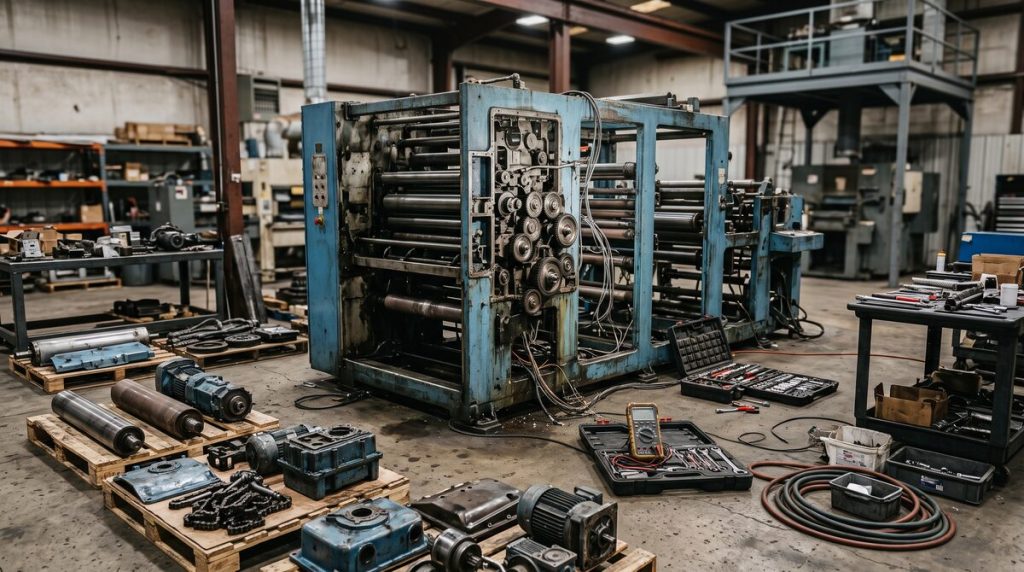
At some point every converting line reaches a decision. The machine still makes product, the maintenance log is getting longer, and the question of whether to rebuild or replace it stops being theoretical. It is a difficult call, and it is made harder by the fact that the two options are usually compared on price alone.
Capital spending patterns show which way most manufacturers lean. In 2022, U.S. employer businesses spent $1,115.0 billion on new equipment, while used equipment accounted for $61.8 billion, or 5.3 percent of total equipment spending, according to Census Bureau figures published on 28 February 2024. Total manufacturing capital expenditure reached $314.3 billion that year. The overwhelming share of capital goes to new assets, which means the rebuild route is often evaluated less rigorously than the purchase it competes with.
What Actually Determines the Answer
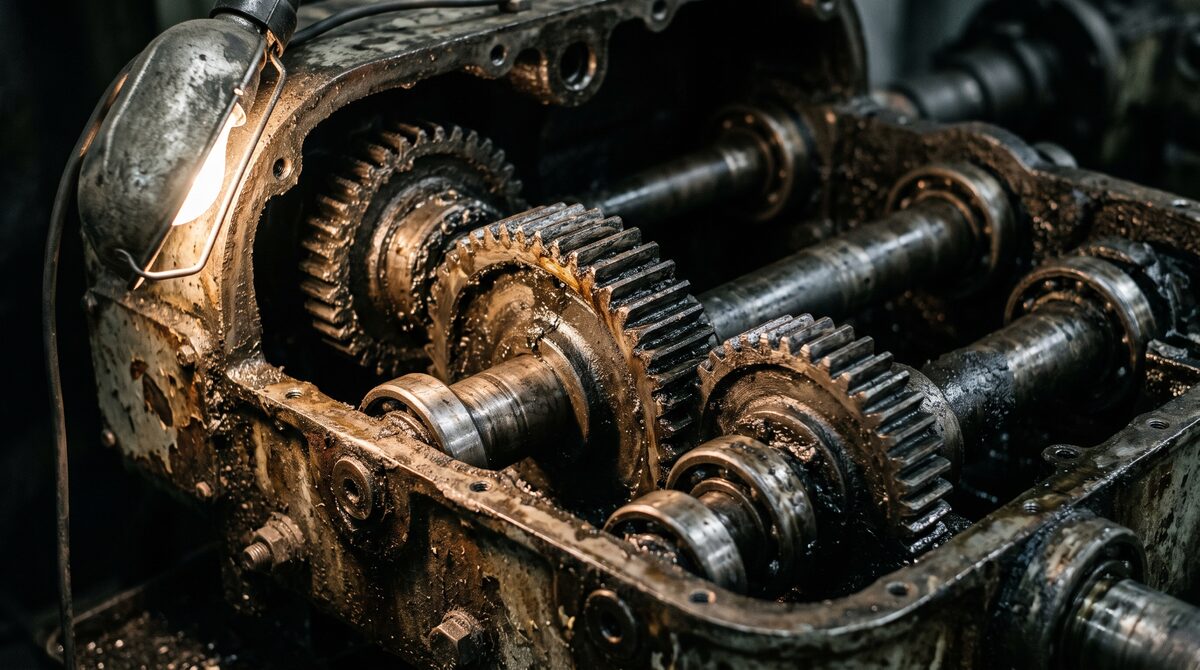
The condition of the frame and the machined surfaces. This is the part of a converting machine that cannot be bought back cheaply. Bed alignment, roll journals, bearing housings, and structural rigidity either survived the decades or did not. A machine whose geometry is intact is a different proposition from one that has been repaired into shape.
How much of the machine sits on unsupported platforms. One obsolete component is a substitution. An entire control architecture at end-of-support is a rebuild. Working out which of these applies is the subject of how parts obsolescence develops on a converting line.
Whether the process has changed. A machine built for one substrate at one width and one rate may be running something different now. When the current product sits outside what the machine was designed around, a rebuild returns it to a specification nobody needs any more.
Documentation. A rebuild on a machine with complete drawings is an engineering exercise. A rebuild on a machine with no drawings begins with measuring what is there.
Who can support it afterwards. A rebuild that leaves the plant dependent on one retiring technician has moved the risk rather than removed it. Part of scoping the work is asking what the maintenance picture looks like once the machine is back in production.
The Schedule Nobody Costs
New capital equipment carries a queue. Census Bureau data released on 4 August 2026 put unfilled orders for manufactured goods at $1,590.6 billion in June 2026, up in twenty-three of the previous twenty-four months, against an unfilled-orders-to-shipments ratio of 6.86. Order backlogs of that scale sit behind delivery dates on purpose-built machinery.
That is a real input to the decision rather than a footnote. A rebuild happens to an asset that is already on the floor, which changes the installation and commissioning picture. A replacement arrives on a lead time, needs floor space, and needs its own tie-in. On the other hand, a rebuild consumes the line while it happens, so production has to be planned around the outage in a way that a parallel installation does not require.
Scoping a Rebuild Properly
A rebuild is not a single product, which is where comparisons tend to break down. The scope can run from a controls and drives replacement on sound mechanics, through re-machining of journals and replacement of wear surfaces, to a strip-down that leaves little beyond the frame. Two quotes described as rebuilds can cover entirely different work.
Writing the scope down before the comparison starts is what makes the exercise meaningful. That means stating which subsystems are being renewed, which are being left, what condition the retained parts are expected to be in, and what the machine is expected to run when it returns. Without that, a rebuild figure and a new-machine figure are not describing comparable outcomes.
Where Each Route Fits
A rebuild tends to suit a machine with sound geometry running a process it was designed for, where the obsolescence is concentrated in controls and wear components. Replacement tends to suit a machine whose frame is compromised, or whose process has moved far enough that the original design no longer matches what the plant makes.
The comparison worth running is not new versus old. It is scope against scope: what a rebuild would actually cover, what a new machine would actually deliver, and what each does to the production schedule. Keeping a current view of parts availability, described in how to build a critical spares list, gives that comparison something concrete to work from.
Elsner Engineering: Converting Machinery Support in Hanover, PA
Elsner Engineering has designed and built custom machinery in Hanover, Pennsylvania since 1934, with engineering, machining, and assembly in one 112,000 square foot facility. Fifty people work in that building, and the quality management system is audited against ISO 9001:2015.
Our Services Include:
- Commercial Series Machinery — Support, spare parts, and field service for converting equipment already in production
- Contract Engineering — Mechanical, electrical, and controls design for machines being reworked or built new
Weighing a rebuild against a replacement?
about the machine, the substrate, and the rate.
Elsner designs and builds custom automation and converting machinery, and also revitalizes legacy equipment with modern controls. Both routes run out of the same Hanover facility, with engineering, machining, and assembly in one building.
Frequently Asked Questions About Rebuilding or Replacing a Converting Machine
01How do I know if a converting machine is worth rebuilding?
Start with the frame and the machined surfaces, since these are what a rebuild cannot easily recover. A machine with sound geometry, running a process close to what it was designed around, with obsolescence concentrated in controls and wear parts, is the clearest candidate for rebuilding.
02What drives the cost of rebuilding a converting machine?
Scope drives it. A controls and drives replacement on sound mechanics sits at one end, and a strip-down that retains little beyond the frame sits at the other. Condition of the retained components, availability of drawings, and the specification the machine must return to all move the figure.
03What does a machine rebuild actually include?
There is no fixed definition, which is why the scope has to be written down. A rebuild may cover controls, drives, wear surfaces, re-machining of journals, guarding, and documentation, in any combination. Two proposals both described as rebuilds can cover substantially different work.
04What affects the lead time on a new custom converting machine?
Design complexity, the availability of bought-in components, and the order backlog at the builder all feed into it. Census Bureau data shows unfilled orders for manufactured goods rising in twenty-three of the twenty-four months to June 2026, so backlog is a real factor in current delivery planning.
05Can an old converting machine be rebuilt to run a different product?
Sometimes, depending on how far the new product sits from the original design. Changes in width, substrate, or running rate may fall within what the frame and drive train can accommodate. When they do not, a rebuild returns the machine to a specification the plant no longer needs.
Works Cited
- U.S. Census Bureau. “Annual Capital Expenditures: 2022.” 28 Feb. 2024, www.census.gov/library/publications/2023/econ/2022-aces-summary.html. Accessed 24 Aug. 2026.
- U.S. Census Bureau. “Monthly Full Report on Manufacturers’ Shipments, Inventories, and Orders.” 4 Aug. 2026, www.census.gov/manufacturing/m3/current/index.html. Accessed 24 Aug. 2026.