
Elsner: Purpose-Built Precision Since 1934 | Hanover, PA
The constraint on converting output in 2026 is increasingly not the machine. It is the person who knows how to bring it back after a web break at two in the morning. Across paper converting, nonwovens, film and filtration plants, the maintenance bench is thinning faster than most operations planned for — and the equipment those people maintain keeps getting older while the people themselves get closer to retirement.
The federal numbers are blunt. The Bureau of Labor Statistics counts 538,300 industrial machinery mechanics, machinery maintenance workers and millwrights as of 2024, with employment projected to reach 607,500 by 2034. That is 13 percent growth against a 3 percent average across all occupations. About 54,200 openings are projected each year over the decade, and BLS attributes most of them to replacement need — workers transferring to other occupations or leaving the labor force entirely. Median pay was $63,510 in May 2024. Millwright employment is projected flat over the same period, partly because of slower growth in the industries that employ them, paper mills among them.
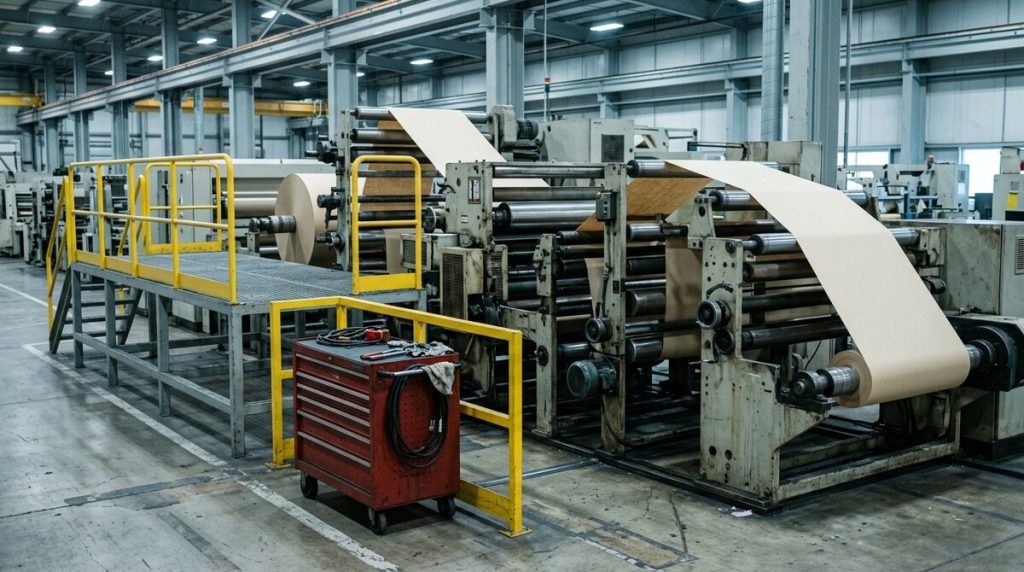
Growth plus attrition is a difficult combination for anyone running equipment that predates the current maintenance staff. A 30-year-old rewinder does not fail the way a 2024 machine fails. Its failure modes live in the heads of people who have watched it for two decades: the tension quirk that only shows up on wide webs, the bearing that always runs warm and always has, the sequence that clears a jam without scrapping a set. None of that appears in the original manual. Most of it was never written down at all, because for twenty years it did not need to be.
The gap is widest exactly where converting plants are most exposed. Newer equipment ships with onboard diagnostics, fault codes and vendor-supported remote troubleshooting. A relay-logic line from the 1990s offers a technician a multimeter and whatever institutional memory happens to be standing next to them. When that memory retires, mean time to repair does not degrade gradually. It steps.
Buying the problem away is harder than it was. Imported capital equipment now carries Section 232 duty exposure, and the reduced rates on that equipment are scheduled to expire at the end of 2027, as covered in the 2026 reset on converting machinery costs. Replacement is a slower and more expensive answer than it looked two years ago, and a new platform still needs someone on shift who understands it.
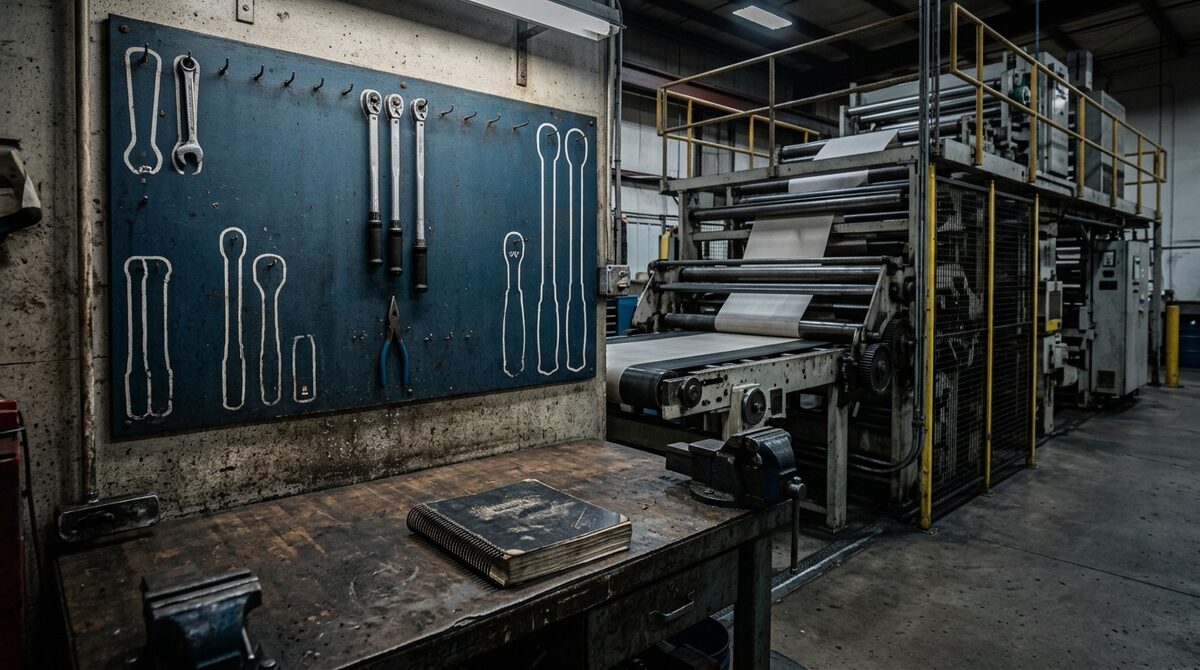
Manufacturers themselves rank the problem near the top. NIST’s Manufacturing Extension Partnership reported that 55 percent of respondents to its FY 2024 client impact survey named employee recruitment and retention a key strategic challenge, up from 41 percent a decade earlier. The finding draws on more than 8,700 responses, roughly 95 percent of them from firms employing fewer than 500 people. Small and mid-sized converters feel this hardest because they carry the least redundancy on the maintenance floor. A single retirement can remove the only person who has ever rebuilt a given unwind stand.
Three responses are doing real work in plants that have gotten ahead of it.
Documentation. Current electrical schematics, mechanical drawings, parts lists and written sequences for every legacy line, captured while the person who knows them is still on payroll. The essential step is reconciling drawings against what is physically installed — legacy machines accumulate undocumented modifications, and a schematic that no longer matches the panel is arguably worse than no schematic, because it sends a new technician confidently in the wrong direction. This work is unglamorous, and it is the highest-return hour a converting plant can spend right now.
Parts strategy. Identifying which components on each line are obsolete, then stocking them, reverse-engineering them, or specifying a supported modern equivalent before a failure forces the decision under pressure. An obsolete drive found during a planned audit is an engineering project with a timeline. The same drive found on a Saturday is a shutdown with a purchase order attached. Wear items, electrical control boards and custom-fabricated components each deserve separate treatment, and the last category is usually the one nobody has a plan for, because it has no catalog number to search.
External depth. A support relationship with people who already know the platform — who answer the phone during a breakdown, who hold manufacturing specifications for parts that were discontinued a decade ago, and who can put a technician on site when the answer is not available over the phone. For a plant running one or two people across every line, that relationship functions as a second maintenance shift without a second payroll.
Thin crews also raise compliance exposure. Shortcuts multiply when one technician covers what two used to: guards not restored after a jam clear, energy isolation performed from memory rather than from a written, equipment-specific procedure. That pattern is why lockout/tagout and machine guarding keep landing on OSHA’s most-cited list, and on a legacy converting line it is a workforce problem at least as much as an engineering one.
None of this is solved by hiring alone. The pipeline BLS describes will not fill 54,200 seats a year on schedule, and every converter competing for those technicians is competing against every other manufacturer in the region — frequently against employers with larger training budgets and newer, better-documented equipment to offer a candidate. The realistic hedge is to make legacy equipment less dependent on scarce institutional memory: documented, supportable, and modern enough at the control layer that a competent new technician can troubleshoot it without having grown up on it.
Elsner Engineering: Converting Equipment Support Since 1934
Elsner supports converting machinery from its Hanover, Pennsylvania facility with an in-stock parts inventory, complete documentation, and field technicians who know legacy platforms. ISO 9001:2015 certified.
Our Services Include:
- Commercial Series Machinery Support — Parts inventory, phone support, on-site field service, operator training and complete rebuild programs
- Customer Support and Technical Assistance — Manuals, schematics and troubleshooting help for older equipment generations
Losing the person who knows your line? Contact Elsner to document, stock and support your legacy converting equipment before that knowledge walks out the door.
Works Cited
- “Industrial Machinery Mechanics, Machinery Maintenance Workers, and Millwrights.” Occupational Outlook Handbook, U.S. Bureau of Labor Statistics, 28 Aug. 2025, www.bls.gov/ooh/installation-maintenance-and-repair/industrial-machinery-mechanics-and-maintenance-workers-and-millwrights.htm. Accessed 23 July 2026.
- Blum, Megean, and Nico Thomas. “Challenges, Solutions, and Success Stories Across the MEP National Network.” Manufacturing Innovation Blog, National Institute of Standards and Technology, 25 Mar. 2025, www.nist.gov/blogs/manufacturing-innovation-blog/challenges-solutions-and-success-stories-across-mep-national. Accessed 23 July 2026.