
Elsner: Purpose-Built Precision Since 1934 | Hanover, PA
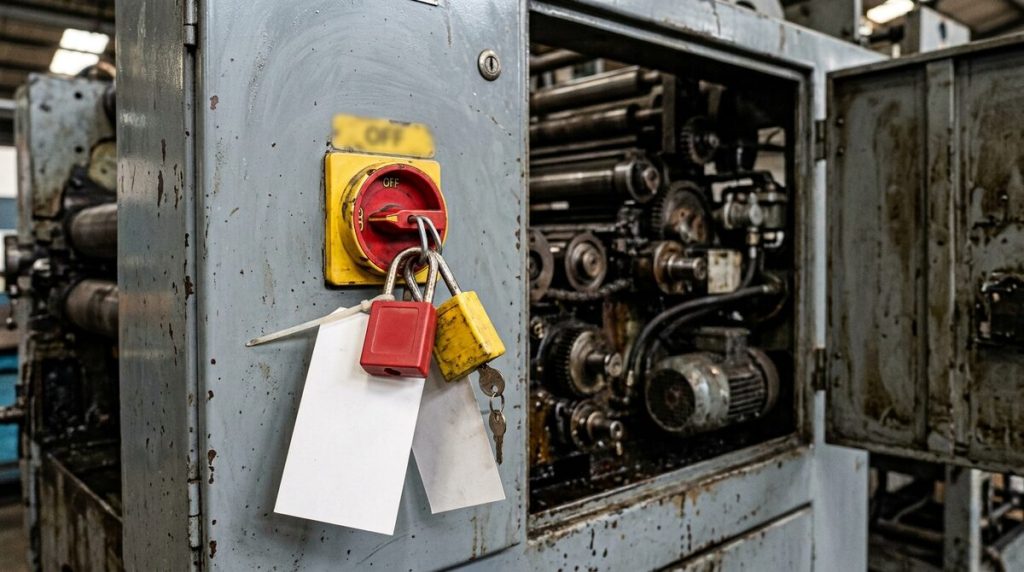
OSHA finalized its most frequently cited standards for fiscal year 2025 this spring, and the list held no surprises — which is precisely the problem. Control of hazardous energy ranked fourth. Machine guarding ranked tenth. Both are servicing-and-maintenance standards. Both point directly at aging production equipment, and on many plant floors, converting lines are among the oldest assets running.
OSHA’s Top 10 list for FY 2025 covers October 1, 2024 through September 30, 2025 across all industries inspected by federal OSHA. Lockout/tagout, 29 CFR 1910.147, governs how hazardous energy is controlled while equipment is being serviced or maintained. Machine guarding, 29 CFR 1910.212, sets the general requirement that machines be guarded against hazards created by point of operation, ingoing nip points, rotating parts, and flying chips or sparks. A converting line generates every one of those categories, frequently within a few feet of one another.
That makes converting equipment an unusually rich source of the failure pattern these standards exist to address. Web threading, splice-outs, blade changes and jam clearing all invite guards to come off, and guards do not always go back on — particularly when the line is down and everyone in the building is watching the clock. Energy sources are plural: electrical, pneumatic and hydraulic, plus stored energy in a tensioned web, a loaded accumulator, a raised roll, and a driven roll that keeps turning well after the drive has stopped. An isolation that looks complete on a checklist is frequently not complete at the nip.
The staffing picture compounds it. When one technician covers what two used to, procedures get compressed and improvised, a dynamic examined in the converting maintenance workforce gap. Written, equipment-specific energy control procedures are exactly the documentation most likely to be missing on a machine installed decades before the current maintenance manager arrived — and a generic plant-wide procedure is not a substitute for one written against a particular machine’s actual energy sources.
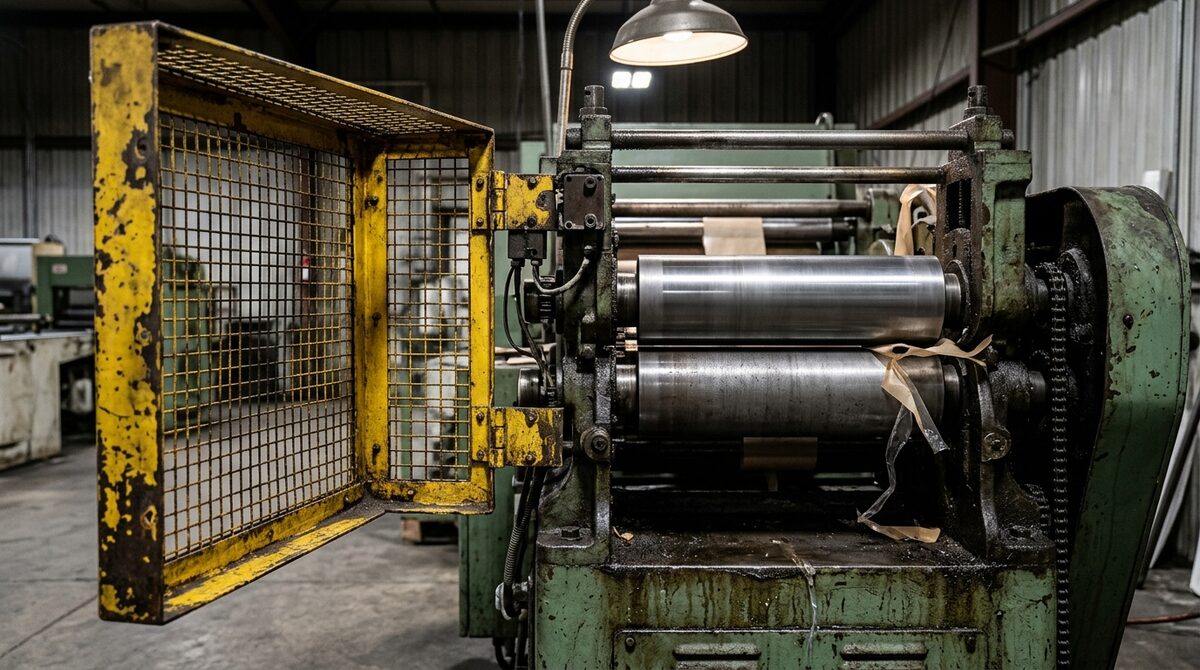
The injury data underneath these standards is not abstract. NIOSH reports that 3,677 workers were killed by contact with objects and equipment between 2018 and 2022, and that in 2022 alone, likely machinery-related fatalities in that category accounted for 738 of 5,846 total workplace deaths, or 12.6 percent. NIOSH frames safeguarding through the hierarchy of controls: eliminate the hazard or engineer it out before falling back on administrative procedure, training and personal protective equipment. On legacy converting equipment, most plants are operating several rungs down that hierarchy without having consciously chosen to.
Moving up it is an engineering exercise rather than a policy one. Interlocked guards that remove motion when opened, instead of a posted rule asking people not to open them. Monitored safety relays or a safety-rated controller in place of a single hardwired contact with no fault detection. Circuit architecture matched to the assessed risk under standards such as NFPA 79 and ISO 13849. Drives that hold zero speed under power rather than coasting to a stop. Emergency stops positioned where an operator actually stands during threading, not where the original panel layout happened to put them. Single-point, clearly labeled energy isolation, so a technician does not have to reconstruct a machine’s energy map from memory at the start of every service call. Legacy relay logic and bolt-on guarding rarely deliver any of that, however well written the program on the shelf may be.
The stakes vary by end market, and converting serves some demanding ones. Plants producing medical nonwovens, bandage products or filtration media carry customer audit obligations alongside regulatory ones, and a documented, engineered safety architecture is increasingly something buyers ask to see rather than assume. In those segments, a guarding and controls retrofit does double duty: it closes a hazard and it produces the records that survive an audit.
Cost is the usual objection, and tariffs have made the comparison less favorable for replacement rather than more, as the 2026 Section 232 reset on converting machinery lays out. A guarding and controls package on a proven machine is domestic engineering, labor and fabricated parts. A new line is an imported capital good with a duty attached and a lead time measured in quarters — during all of which the existing hazard stays exactly where it is.
There is also a documentation dividend that plants consistently underestimate. A safety retrofit forces a complete walk-down: what moves, what stores energy, where the access points are, and what the schematics say versus what is physically installed. Converters routinely discover undocumented modifications during that process — a bypassed interlock from a production push five years ago, a guard fabricated in-house that nobody ever validated, a jumper someone added during a night-shift repair and never removed. Finding those during a planned project is meaningfully cheaper than finding them during an inspection, and dramatically cheaper than finding them during an incident investigation.
The finalized FY 2025 list was posted in April 2026, which means these are the standards compliance officers are actively citing right now. For a converting plant running machines older than the people operating them, the cheapest audit available is an honest internal walk-down: every guard accounted for and functional, every interlock tested rather than assumed, an equipment-specific energy control procedure on file for each line, and drawings that match the panel. Whatever that exercise turns up will be cheaper to fix on your schedule than on someone else’s.
Elsner Engineering: Converting Equipment Support Since 1934
Elsner modernizes converting machinery from its Hanover, Pennsylvania facility, bringing proven equipment up to current control and safety standards without a full line replacement. ISO 9001:2015 certified.
Our Services Include:
- Machine Retrofit and Control System Modernization — Safety system updates, guarding, interlocks, PLC and HMI upgrades, and drive conversions with updated schematics and validation records
- Commercial Series Machinery Support — Equipment evaluation, upgrade recommendations and documented rebuild programs for legacy converting lines
Not sure what your older lines would fail on? Contact Elsner to schedule an equipment assessment and safety walk-down.
Disclaimer
This article is general information about published federal standards and data. It is not legal, regulatory or safety-compliance advice, and it does not substitute for a hazard assessment of your specific equipment. Consult OSHA’s published standards and a qualified safety professional for guidance on your facility.
Works Cited
- “Top 10 Most Frequently Cited Standards.” Occupational Safety and Health Administration, U.S. Department of Labor, 15 Apr. 2026, www.osha.gov/top10citedstandards. Accessed 23 July 2026.
- “Machine Safety in the Workplace.” National Institute for Occupational Safety and Health, Centers for Disease Control and Prevention, 24 Jan. 2024, www.cdc.gov/niosh/machine-safety/about/index.html. Accessed 23 July 2026.