
Spiral Winding vs. Convolute Winding: Choosing the Right Technology for Your Core Production
Elsner Engineering Works | Hanover, PA
Every paper tube and core starts with the same question: spiral or convolute? The answer shapes the machine you buy, the material specifications you run, the applications you can serve, and the production economics your operation achieves. At Elsner Engineering Works, purpose-built precision since 1934, we've helped core manufacturers navigate exactly this decision — yet a surprising number of manufacturers enter that decision with an incomplete picture of how the two technologies actually differ — in the physics of the winding process, in the structural characteristics of the finished tube, and in the operational profiles of the equipment required to produce each type at commercial scale.
The distinction matters more today than it did a decade ago. The global paper tubes and cores market is projected to reach $10.9 billion by 2034 at a 7.3 percent CAGR, with growth distributed across industrial cores, film and flexible packaging, textile applications, and specialty engineered products. Each of those growth segments has different requirements, and those requirements align with the winding technology in ways that make equipment selection a strategic decision rather than a commoditized procurement. Getting the choice right positions a manufacturer to serve high-growth, specification-sensitive applications competitively. Getting it wrong means either producing tubes that underperform for their intended use or operating equipment that cannot economically serve the markets where demand is strongest.
How Spiral Winding Works — and What It Produces
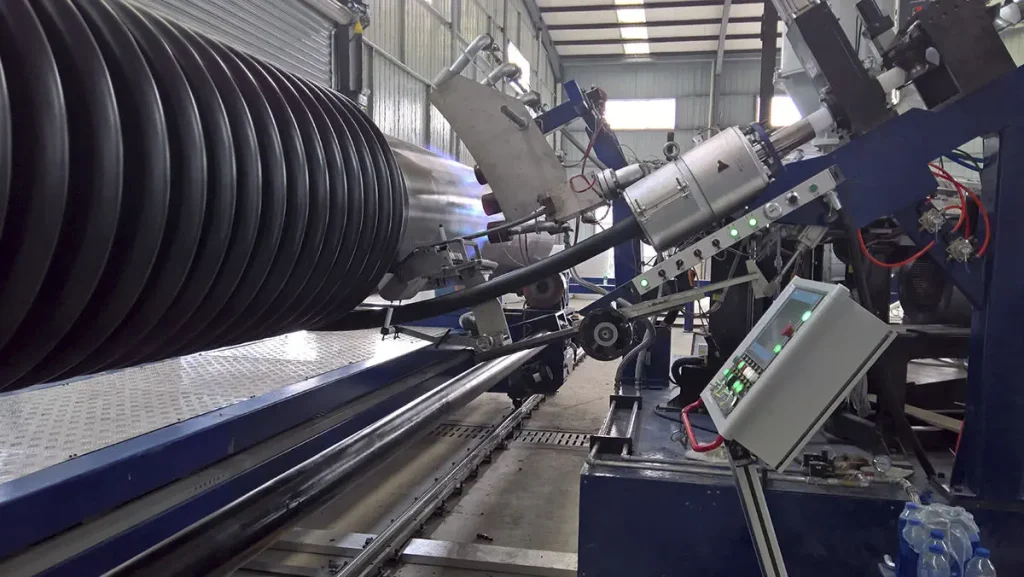
Spiral winding feeds multiple narrow paper strips — called plies or webs — onto a steel mandrel at an angle, winding them in a continuous helical pattern. Each ply travels from a separate supply reel, passes through an adhesive application system, and is laid against the previous ply at a consistent angle as the mandrel rotates. The angle of wrap, the tension on each ply, and the number of plies combine to determine the wall thickness, compressive strength, and surface characteristics of the finished tube. A flying knife cuts the continuously advancing tube into specified lengths without stopping the winding process, enabling genuinely continuous production.
The structural result of this geometry is a tube whose wall integrity comes from the angular interlock of multiple layers bonded under controlled tension. Spiral-wound tubes offer excellent column strength for their wall thickness, smooth exterior surfaces, and consistent dimensional geometry across the full length of the tube. The continuous production model makes spiral winding inherently efficient at volume — once the machine is running, output is limited primarily by the feed speed and the cutting system rather than by the winding cycle itself.
These characteristics make spiral winding the dominant technology for most paper core applications: tissue and towel cores, film support cores, tape and label cores, paper converting cores, and the vast majority of general industrial cores. The smooth surface and consistent roundness that spiral winding produces are required by the custom automation machinery these cores run on — a winding machine or printing press designed to run at speed on precise core geometry cannot accommodate the dimensional variability that inferior winding technology introduces.
How Convolute Winding Works — and Where It Excels
Convolute winding wraps a single wide sheet of paper parallel to the mandrel's axis — at a right angle to the tube's length — layer upon layer until the specified wall thickness is achieved. The mandrel rotates while the paper web wraps around it, with each layer bonded to the previous one through adhesive application. When the tube reaches the target wall thickness, the mandrel stops, the tube is removed, and the process starts again with the next blank.
The structural physics of convolute winding produce a tube fundamentally different from a spiral-wound product. Because the paper fibers run parallel to the tube's axis rather than at an angle, convolute-wound tubes develop very high beam strength — the ability to resist bending and crushing loads applied perpendicular to the tube's length. Convolute cores with the same wall thickness as their spiral-wound equivalents can be 30 percent stronger in radial crush resistance, a property critical in heavy-duty industrial applications where cores must support substantial roll weights during winding, transit, and unwinding.
This strength profile makes convolute winding the preferred technology for specific demanding applications: textile and yarn winding cores where the core must withstand the mechanical forces of high-tension winding and the weight of large yarn packages; heavy-duty industrial cores for construction materials, carpet, and metal foil where load-bearing requirements exceed what spiral construction can deliver at equivalent wall thickness; and specialty applications such as pyrotechnics and fire hose mandrels where internal pressure resistance is the defining performance criterion.
Convolute winding also produces a distinctive tube geometry — a visible straight seam running the length of the tube — and a surface that, while less smooth than spiral-wound product, is entirely acceptable for applications where the contact conditions do not require the mirror finish that film and high-speed converting applications demand.
The Production Economics Decision
Beyond the structural and application differences, spiral and convolute winding present different production economic profiles that matter directly to the capital investment decision.
Spiral winding is inherently a continuous-process technology. Once a spiral winder is running a product specification, it produces tubes at a rate determined by line speed and cutting cadence. Changeovers between tube dimensions require adjusting ply widths, mandrel tooling, and cutting parameters — a planned downtime event, but one that modern quick-changeover designs minimize significantly. The continuous production model is highly efficient for long runs of consistent specifications and produces excellent throughput economics when the order book supports that pattern.
Convolute winding is fundamentally a batch-process technology. Each tube is wound individually from a single wide web, and production rate is determined by the winding cycle time per tube. This makes convolute winding inherently less efficient than spiral for high-volume production of standard cores, but it also makes convolute better suited to short-run, wide-diameter, or heavy-wall specifications where the tooling and setup economics of spiral winding become less favorable. A convolute winder producing large-diameter, heavy-wall textile cores or industrial cores is operating in a segment where spiral winding's continuous production advantage does not translate to a meaningful cost difference.
Understanding how contract engineering expertise integrates with equipment selection helps manufacturers avoid under-specifying production systems that will constrain their capacity as order books grow. The tube recut and finishing dimension of the decision rounds out the technology picture. Both spiral and convolute wound tubes require cutting to final length, and the precision of that cutting is where dimensional accuracy is ultimately locked in. As examined in Why Core Dimensional Precision Is the Most Under-Specified Requirement in Tube Purchasing — and What to Do About It, the quality of the cut-off system determines whether a tube that exits the winder with excellent roundness and consistent wall thickness actually reaches the customer at the dimensional specification that their converting equipment requires.
Matching Technology to Application: The Decision Framework
For a core manufacturer evaluating equipment investment, the winding technology decision should follow a clear sequence: first define the applications you serve or intend to serve, then map those applications to their structural requirements, and finally select the equipment that produces those requirements most economically at the volumes your market supports.
Film and flexible packaging cores, tape and label cores, tissue and towel cores, and general converting cores belong overwhelmingly in the spiral winding category. These applications require the consistent dimensional geometry, smooth surface, and continuous production efficiency that spiral winding delivers. As explored in The Flexible Packaging Film Industry Is Running on Precision Spiral Cores — and Demand Is Still Growing, the film converting market in particular places precision requirements on core quality that make spiral winding's structural consistency a competitive prerequisite.
Textile yarn and fabric cores, heavy-duty industrial cores, and specialty engineered cores frequently belong in the convolute winding category, or in a combination operation where both technologies serve different market segments. A manufacturer serving both textile and packaging markets may operate spiral winders for the majority of their volume alongside convolute equipment for the heavy-duty applications that require its specific strength profile. Manufacturers evaluating their industries served and the core requirements of each segment will find that the application portfolio almost always dictates the technology mix before the capital budget conversation begins.
The U.S. Bureau of Labor Statistics productivity data for fiber, yarn, and thread mills documents a 12.5 percent productivity gain in that sector in 2024 — the leading nondurable goods manufacturing result — reflecting the investment these operations are making in their winding infrastructure and the competitive pressure driving them toward equipment that delivers consistent, high-quality cores at the throughput rates automated textile winding equipment demands. Core manufacturers serving this market need to understand that requirement and match their technology and quality systems to it.
Elsner's Paco Winder lineup — spanning MW Series spiral winders, C-Series convolute winders, AR Series automatic tube recutters, and cut-off saws — provides the equipment foundation for both technology paths, from single-machine introductory configurations to complete production systems. The decision between them starts with the application, and the application starts with understanding exactly what each technology produces and why.
Elsner Engineering Works: Paco Winders Built to Specification
Elsner has been engineering precision manufacturing solutions from Hanover, Pennsylvania since 1934. Our Paco Winders deliver the tension control, dimensional consistency, and changeover flexibility that core manufacturers need to serve demanding applications at competitive economics.
Our Equipment Includes:
- Paco Winders — MW Series spiral winders, C-Series convolute winders, AR Series automatic tube recutters, and cut-off saws engineered for high-quality tube and core production
- Custom Automation Solutions — Turnkey winding systems designed to match your specific production requirements and application portfolio
Ready to Discuss Your Winding Technology Requirements? Contact Elsner at (717) 637-5991 to talk through your application, volume, and dimensional specifications with our engineering team.
Works Cited
"Productivity and Costs by Industry: Manufacturing and Mining Industries — 2024." U.S. Bureau of Labor Statistics, U.S. Department of Labor, Apr. 2025, www.bls.gov/news.release/prin.nr0.htm. Accessed 26 Mar. 2026.
"Paper Tubes and Cores Market 2025." USD Analytics, www.usdanalytics.com/industry-reports/paper-tubes-and-cores-market. Accessed 26 Mar. 2026.
Related Articles
- The Flexible Packaging Film Industry Is Running on Precision Spiral Cores — and Demand Is Still Growing
- Why Core Dimensional Precision Is the Most Under-Specified Requirement in Tube Purchasing — and What to Do About It