
The Paper Tube Industry's Labor Crisis Is Accelerating—Automation Is No Longer Optional
Elsner: Purpose Built Precision Since 1934
Paper tube and core manufacturers across the United States are confronting an uncomfortable paradox: demand for their products is growing at rates not seen in decades, while the workforce available to produce those products is shrinking. The timing could not be worse. Regulatory mandates restricting single-use plastics are converting entire packaging categories from plastic to paper-based alternatives, e-commerce growth continues driving demand for protective shipping tubes, and traditional industrial customers in textiles, film, and paper converting maintain steady baseline requirements. As a trusted manufacturing partner for industrial automation solutions, Elsner Engineering Works Inc has observed this paper tube manufacturing automation labor shortage intensify across the industry. The orders are there. The workers are not.
Manufacturing employment in the United States has experienced a structural decline for four decades, falling from a peak of 19.6 million workers in 1979 to roughly 12.8 million before the pandemic. While manufacturing has recovered some positions in recent years, the sector now competes for labor against logistics, healthcare, technology, and construction industries that often offer comparable or superior compensation without the physical demands of production floor work. The Bureau of Labor Statistics documents the manufacturing sector's employment dynamics extensively, tracking wages, hours, productivity, and turnover across seventy-two manufacturing industry classifications. The data consistently shows that manufacturing faces persistent workforce challenges even as output and productivity have increased—a divergence that underscores the sector's growing dependence on automation for paper tube production to maintain production capacity.
Paper tube and core manufacturing sits at the intersection of these broader trends with additional complications specific to the industry. The work requires operators who understand paper characteristics, adhesive behavior, tension dynamics, and the mechanical judgment needed to produce consistent products across variable raw material conditions. This expertise develops over years of experience, and the industry's aging workforce is retiring faster than new operators can be recruited and trained. A plant manager who loses a thirty-year veteran winder operator does not replace that knowledge by hiring someone off the street, even if someone were available to hire.
The Math That Forces the Automation Decision
The workforce arithmetic confronting tube and core manufacturers is straightforward and unforgiving. A typical spiral winding operation requires skilled operators to manage web threading, tension adjustment, adhesive application monitoring, changeover execution, and quality verification. When the operation runs two or three shifts to meet demand—as many manufacturers increasingly must—the staffing requirement multiplies while the available labor pool does not. Overtime fills gaps temporarily but creates fatigue-related quality problems and accelerates burnout that drives the very turnover manufacturers are trying to prevent.
The economic equation has tilted decisively. A decade ago, the capital cost of automated winding equipment could be difficult to justify against relatively available and affordable labor. Today, the calculation has reversed. Labor costs have increased substantially while availability has decreased. Training costs have escalated as the knowledge gap between retiring experts and incoming workers has widened. Quality costs associated with operator variability have risen as customers demand tighter specifications for consumer packaging applications. Meanwhile, automation technology for paper tube manufacturing has improved in capability while decreasing in relative cost through better controls, more intuitive interfaces, and modular designs that reduce installation complexity.
The manufacturers who recognize this inflection point are investing in custom automation machinery that reduces operator dependency while increasing production consistency. Automatic core ejection systems eliminate manual handling that previously required dedicated labor at the end of every winding cycle. Programmable winding parameters allow operators to recall proven recipes for different products rather than relying on individual judgment for tension settings and speed adjustments. Quick changeover designs reduce the skilled labor hours consumed by product transitions—hours that represent some of the most expensive and difficult-to-staff time in any tube manufacturing operation.
As explored in Plastic Packaging Bans Are Creating a $5.8 Billion Paper Tube Boom—And Most Core Manufacturers Aren't Ready, the demand surge from plastic-to-paper packaging conversion makes this workforce gap even more urgent. Manufacturers cannot capture the growth opportunity if they lack the operators to run additional shifts or the equipment flexibility to serve diverse new customers.
What Automation Actually Means for Tube Manufacturing
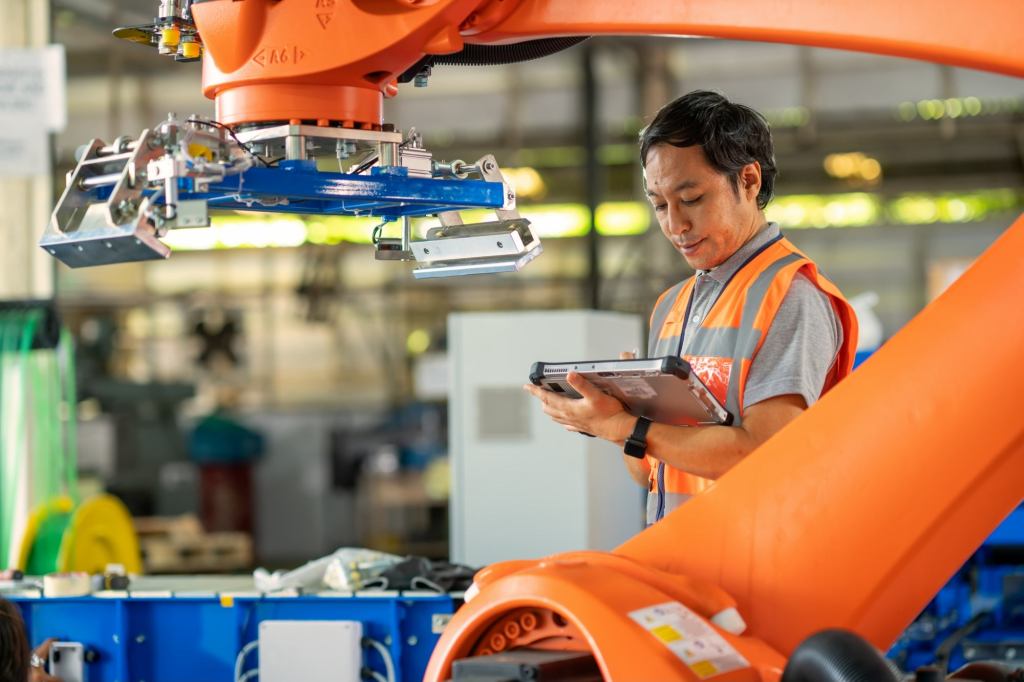
The term automation carries different implications across manufacturing sectors, and in paper tube production, it does not mean replacing humans with robots. It means equipping the humans you have with machinery that amplifies their productivity, reduces their physical burden, and ensures consistency that manual processes cannot maintain across extended production runs. The distinction matters because it addresses the most common objection plant managers raise: that their operation is too specialized, their products too variable, or their volumes too modest to justify automation.
Modern tube winding equipment achieves automation through precision control systems rather than wholesale process replacement. Electronic tension control maintains consistent web tension regardless of spool diameter changes during a production run—a variable that manual operators must continuously monitor and adjust, diverting attention from other quality-critical tasks. Servo-driven systems provide positioning accuracy for slitting and winding operations that manual adjustment cannot match, particularly during the start and end phases of each winding cycle, where most quality variation occurs. Real-time monitoring systems track dimensional accuracy during production rather than relying on post-production inspection that discovers defects only after material has been consumed.
These capabilities do not eliminate the need for skilled operators. They transform the operator's role from continuous manual intervention to supervisory management of automated processes. One experienced operator monitoring multiple automated winding positions produces more output at higher consistency than multiple operators running manual or semi-automatic machines. This leverage effect is the key to solving the labor shortage in paper tube manufacturing: not finding more workers, but enabling each worker to accomplish dramatically more.
The National Institute of Standards and Technology predicts that small manufacturers will increasingly implement automated systems to streamline repetitive tasks, improve accuracy, and accelerate production speeds. NIST specifically identifies labor shortages as a primary driver of automation adoption, noting that technologies once accessible only to large enterprises are becoming practical for smaller operations. For paper tube manufacturers—many of which are small to mid-sized operations—this democratization of automation technology arrives precisely when the labor crisis makes it essential.
The Quality Dimension of the Workforce Problem
Labor shortages create quality problems that compound the economic damage beyond lost production hours. When experienced operators retire and are replaced by less skilled workers—or when overtime demands push fatigued operators through extended shifts—the consistency that customers depend on degrades. In industrial core applications, modest quality variation might be tolerable. In the consumer packaging applications that represent the industry's growth frontier, quality variation is disqualifying.
A food brand converting from plastic containers to paper composite cans does not merely require a certain wall thickness and diameter. That brand requires those specifications to be maintained within tolerances tight enough to ensure automated filling equipment functions properly, barrier coatings adhere uniformly, printed labels align precisely, and stacked cases maintain structural integrity through distribution channels. A single shipment of out-of-specification tubes that jams a customer's filling line does not just create a quality complaint—it jeopardizes the entire supplier relationship and validates the customer's worst fears about converting from a familiar plastic format.
Automated winding equipment addresses this quality dimension by removing the variability inherent in human-dependent processes. Consistent tension produces uniform wall density. Controlled adhesive application prevents delamination. Precision slitting eliminates edge irregularities that cause downstream processing problems. These outcomes do not depend on which operator is running the machine, whether it is the first hour of the shift or the eleventh, or whether the operator is a twenty-year veteran or a six-month hire. The machine produces the same result regardless, and in a market where quality consistency in paper tube manufacturing determines whether manufacturers win or lose the consumer packaging opportunity, that reliability is worth more than any labor cost savings.
Building an Automation Roadmap for Growing Operations
Manufacturers considering automation investments face decisions that extend well beyond equipment selection. The transition from labor-dependent to automation-assisted production requires thoughtful planning that accounts for current capabilities, growth projections, workforce development, and financial constraints. A phased approach typically serves tube manufacturers better than wholesale conversion because it allows the organization to develop automation competencies incrementally while maintaining production continuity.
The first phase for most operations involves automating the processes that consume the most skilled labor hours per unit of output. Changeover operations frequently represent this highest-impact opportunity because they require the most experienced operators, consume the most non-productive time, and introduce the greatest quality risk as settings are adjusted between products. Equipment designed for quick changeover—with stored recipes, repeatable adjustments, and minimal manual intervention—can reduce changeover time by fifty percent or more while simultaneously improving the consistency of the first units produced after each transition.
The second phase typically addresses in-process quality monitoring that currently depends on operator judgment and periodic manual inspection. Automated measurement systems that verify tube dimensions, wall thickness, and surface quality during production rather than after production catch deviations before they produce scrap. This capability becomes increasingly valuable as product mix diversifies and changeover frequency increases, because each specification transition creates a window of quality risk that automated monitoring closes.
The third phase extends automation to material handling—the loading, unloading, transfer, and palletizing operations that represent some of the most physically demanding and least skilled tasks in tube manufacturing. These operations consume labor hours that could be redeployed to higher-value activities while also representing significant workplace safety exposure. Reducing manual material handling simultaneously addresses labor availability, safety costs, and production throughput.
How the specific demands of e-commerce packaging are accelerating this automation investment timeline is examined in E-Commerce Is Reshaping Paper Tube Specifications—And Forcing Core Manufacturers to Rethink Their Production Lines, which documents the specification complexity that new market segments demand from tube and core producers.
The Cost of Waiting
Every month that a tube manufacturer delays automation investment, the cost of inaction increases on multiple dimensions simultaneously. Labor costs continue rising while availability continues declining. Customer specifications continue tightening while manual processes continue struggling to meet them. Market share continues shifting toward better-equipped operations while underequipped manufacturers watch their competitive position erode. And the demand surge from plastic packaging conversion continues building while capacity-constrained manufacturers turn away business they could profitably serve if they had the equipment to produce it.
The manufacturers who will define the next decade of the paper tube and core industry are those investing now in equipment that solves the labor equation while simultaneously positioning their operations for the quality demands of consumer packaging markets. Those who wait for the labor market to improve will wait indefinitely, because the structural forces driving workforce scarcity in manufacturing are permanent. The only variable is whether a given manufacturer addresses reality through strategic automation investment or allows that reality to slowly dismantle their competitive position.
Elsner: Automation That Amplifies Your Workforce
Elsner Engineering Works has been engineering purpose-built manufacturing solutions from Hanover, Pennsylvania, since 1934. Our Paco Winders incorporate the precision controls, automated functions, and quick-changeover capability that paper tube manufacturers need to produce more with fewer operators while meeting the tighter specifications today's markets demand.
Our Equipment Includes:
- Paco Winders - Spiral and convolute winding systems with automatic core ejection, precision tension control, and programmable parameters that reduce operator dependency
- Custom Automation Solutions - Engineered systems designed to integrate with your existing production workflow and scale with your growth
Ready to Solve Your Workforce Equation? Contact Elsner at (717) 637-5991 to discuss how automated Paco Winding equipment can help your operation produce more with the team you have.
Works Cited
"Manufacturing: NAICS 31-33." Industries at a Glance, U.S. Bureau of Labor Statistics, U.S. Department of Labor, www.bls.gov/iag/tgs/iag31-33.htm. Accessed 24 Feb. 2026.
"What's Coming for US Manufacturing in 2025?" Manufacturing Innovation Blog, National Institute of Standards and Technology, U.S. Department of Commerce, www.nist.gov/blogs/manufacturing-innovation-blog/whats-coming-us-manufacturing-2025. Accessed 24 Feb. 2026.
Related Articles
- Plastic Packaging Bans Are Creating a $5.8 Billion Paper Tube Boom—And Most Core Manufacturers Aren't Ready
- E-Commerce Is Reshaping Paper Tube Specifications—And Forcing Core Manufacturers to Rethink Their Production Lines