
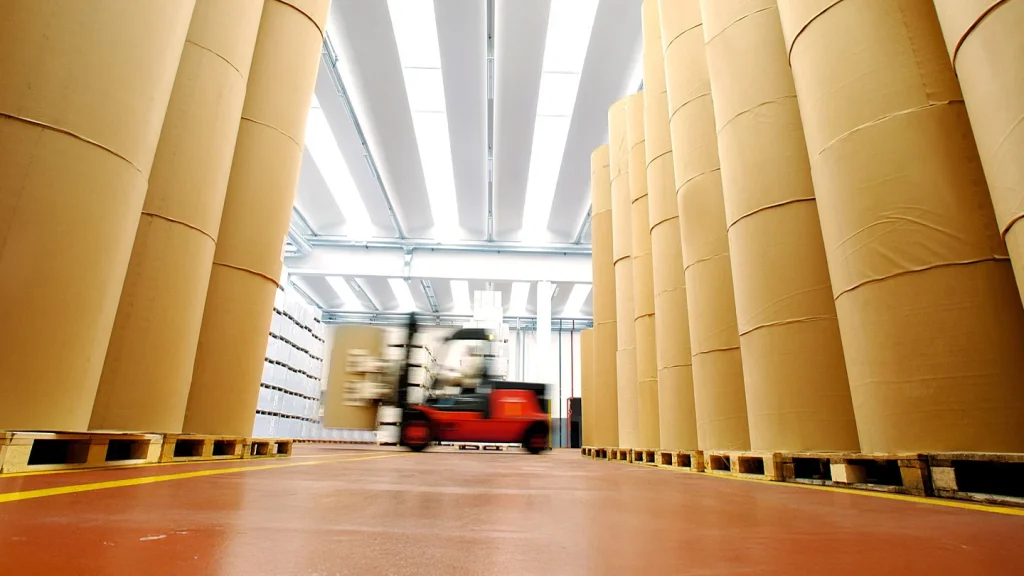
E-Commerce Is Reshaping Paper Tube Specifications—And Forcing Core Manufacturers to Rethink Their Production Lines
Elsner: Purpose Built Precision Since 1934
The package that arrives at a customer's doorstep after an online purchase has traveled through a distribution system engineered to move millions of items at minimum cost. It has been conveyed, sorted, stacked, dropped, tossed, and compressed alongside packages of wildly different sizes and weights. For paper tube and core manufacturers, this brutal logistics environment is creating an entirely new set of e-commerce paper tube packaging specifications and equipment needs that bear little resemblance to the industrial cores their equipment was originally designed to produce. Elsner Engineering Works Inc provides the precision winding technology required to meet these evolving standards.
The scale of this shift is difficult to overstate. Global e-commerce continues expanding parcel volumes at rates that compound year over year, directly increasing demand for paper-based protective packaging and shipping tubes. Industry projections consistently identify e-commerce logistics as a primary driver of paper tube market growth through 2035 and beyond. Protective mailing tubes for documents, posters, artwork, and rolled goods require specialized custom automation machinery to maintain structural integrity during transit. Each application presents distinct technical requirements that challenge the production capabilities of conventional tube winding equipment.
The EPA tracks the material composition of municipal solid waste extensively, and its national overview of materials and waste data reveals why paper-based packaging occupies such a favorable position in the evolving regulatory landscape: paper and paperboard materials constituted the largest component of municipal solid waste at 23.1 percent of total generation, while also accounting for approximately sixty-seven percent of all recycled material by tonnage. This combination—high generation volume paired with high recyclability—positions paper tubes as the sustainable packaging solution that e-commerce brands increasingly require to satisfy both regulatory mandates and consumer expectations for environmentally responsible packaging.
The Specification Complexity E-Commerce Creates
Traditional industrial cores serve a relatively narrow specification range. A textile manufacturer needs cores of specific inside diameter and wall thickness to fit their winding equipment, with sufficient compressive strength to support the weight of wound material. These specifications remain stable for years because the downstream equipment they serve does not change frequently. A tube manufacturer supplying industrial cores can optimize their winding equipment for a limited number of configurations and run long production cycles with minimal changeover.
E-commerce has shattered this predictability. A single tube manufacturer serving the e-commerce packaging market might produce mailing tubes in eight different diameters, three wall thicknesses, and twelve cut lengths during a single production week. Each specification transition requires a retrofit of mindset and equipment: new mandrel setup, tension adjustment, adhesive recalibration, speed optimization, and quality verification. On equipment designed for long production runs with infrequent changeover, this specification diversity destroys productivity and introduces quality risk at every transition point.
The physical performance requirements for e-commerce tubes also exceed those of many industrial cores. Mailing tubes must withstand the compression forces of automated parcel sorting systems that apply loads from unpredictable directions. They must resist moisture exposure during weather-variable delivery conditions. They must provide sufficient rigidity to protect contents without adding weight that increases shipping costs. And they must present an acceptable visual appearance because the tube itself becomes part of the customer's unboxing experience—a brand touchpoint that influences purchase satisfaction and repeat buying behavior.
These combined demands—specification diversity, rapid changeover, tight dimensional tolerances, superior physical performance, and visual quality—define an equipment capability profile that most legacy tube winding machinery cannot deliver. The manufacturers capturing the e-commerce packaging business are those operating equipment designed for precisely this production environment: precision controls that maintain quality across diverse specifications, quick-changeover systems that minimize lost time between products, and automated functions that ensure consistency regardless of product mix complexity.
Lightweight Tubes, Heavy Engineering Challenges
One of the most significant technical trends in e-commerce paper tube production is the relentless drive toward lighter weight without sacrificing structural performance. Every gram of packaging weight increases shipping cost, and e-commerce fulfillment operations optimize packaging weight obsessively because those costs multiply across millions of shipments annually. The ideal e-commerce tube is the lightest construction that reliably protects its contents through the distribution system—and finding that optimal point requires winding equipment capable of working with lighter paper grades at tighter tolerances than traditional cores demand.
Lighter paper grades are less forgiving during the winding process. They are more susceptible to tension-induced wrinkling, more sensitive to adhesive application variation, and more prone to dimensional instability during the curing phase after winding. Producing consistent lightweight tubes at production speeds that maintain economic viability requires tension control systems that respond to paper behavior in real time rather than relying on static settings that operators adjust periodically. Many top-tier manufacturers rely on PACO winders to achieve this level of granular control. It requires adhesive application systems that distribute precisely calibrated quantities uniformly across the web rather than applying excess adhesive that adds unnecessary weight and cost. And it requires slitting systems that produce clean edges without the fiber tearing that lighter paper stocks experience when cutting systems are not properly maintained or adjusted.
The engineering challenge extends beyond the winding process itself. Lightweight tubes must achieve compressive strength specifications through optimized lamination geometry rather than through material mass. This means the winding angle, layer count, adhesive penetration depth, and paper grain orientation all contribute to structural performance in ways that become more critical as material weight decreases. Equipment that allows operators to control these parameters precisely—and to recall proven configurations for different products through stored recipe systems—produces lightweight tubes that meet performance specifications consistently. This is a core focus at the Elsner Tech Center, where we refine the science of spiral winding for modern logistics. Equipment that depends on operator judgment for these adjustments produces inconsistent results that generate scrap, customer complaints, and ultimately lost business.
As documented in The Paper Tube Industry's Labor Crisis Is Accelerating—Automation Is No Longer Optional, the workforce challenges facing tube manufacturers make this precision equipment requirement even more pressing. The operators who possessed the intuitive understanding to produce quality lightweight tubes through manual adjustment are retiring. Their replacements need equipment intelligent enough to compensate for developing expertise.
The Reshoring Effect on Domestic Tube Demand
E-commerce's impact on paper tube demand intersects with a broader manufacturing trend that amplifies domestic production requirements. The NIST Manufacturing Extension Partnership network—which supports small and medium-sized manufacturers across all fifty states through technical assistance, workforce development, and operational improvement programs—has identified reshoring as a defining trend for American manufacturing. Companies are reevaluating offshore supply chains and bringing production back to the United States to reduce vulnerability to international disruptions, improve delivery responsiveness, and comply with domestic content requirements in government procurement.
Reshoring manufacturing operations increases domestic demand for paper tubes and cores from two directions simultaneously. The reshored manufacturing facilities themselves require industrial cores for their production processes—winding cores for textile operations, support cores for film and foil production, protective tubes for shipping manufactured goods. Additionally, reshored operations that sell products through e-commerce channels generate demand for the protective packaging tubes and composite containers that online fulfillment requires. Each reshored factory creates a concentrated, local demand source for tube and core products that did not exist when that production occurred overseas. Utilizing a domestic manufacturing partner for these components ensures supply chain stability.
For domestic tube manufacturers, reshoring amplifies the e-commerce paper tube packaging specifications equipment challenge because reshored operations often produce higher-value products with tighter quality requirements than the commodity production that originally moved offshore. These operations demand precision cores that support automated processing equipment, and they expect the same just-in-time delivery responsiveness they receive from other domestic suppliers. Meeting these expectations requires production capabilities—both equipment and systems—that can serve diverse specifications at high quality with short lead times.
The combination of e-commerce growth, reshoring demand, and plastic-to-paper packaging conversion creates an unprecedented market opportunity for domestic tube and core manufacturers. As explored in Plastic Packaging Bans Are Creating a $5.8 Billion Paper Tube Boom—And Most Core Manufacturers Aren't Ready, the manufacturers who capture this opportunity will be those whose equipment allows them to serve the full spectrum of emerging demand rather than remaining confined to traditional industrial specifications that represent the market's slowest-growing segment. Many firms are turning to contract manufacturing to bridge the gap while they upgrade their in-house capabilities.
What Modern Production Capability Looks Like
The equipment profile that e-commerce tube production demands differs from traditional industrial core equipment in several critical dimensions. Understanding these differences helps manufacturers evaluate whether their current capabilities match the market opportunity or whether equipment investment is needed to compete effectively.
Variable speed operation matters more in e-commerce production than in traditional core manufacturing because the diverse product mix requires speed optimization for each specification. A thin-wall mailing tube and a heavy-wall industrial core cannot be wound at the same speed without compromising quality on one or both products. Many manufacturers are integrating commercial series machinery to handle these varied runs with high efficiency. Equipment that adjusts speed smoothly across a wide range without sacrificing tension control or adhesive application consistency allows manufacturers to optimize each product independently rather than accepting compromises that limit quality or throughput.
Precision slitting capability determines whether a manufacturer can produce the clean-cut tubes that e-commerce customers require. End consumers see the tube ends when they open packages, and rough, fibrous, or uneven cuts create a quality impression that reflects on the brand using the packaging. Advanced machining techniques in the construction of these blades ensure perpendicular cuts with minimal dust generation. Commercial slitting systems that produce clean, perpendicular cuts with minimal dust generation also reduce secondary finishing operations that add labor cost and production time. For manufacturers serving e-commerce brands that are sensitive to presentation quality, slitting performance directly impacts competitiveness.
Consistent adhesive application has always mattered in tube production, but e-commerce applications raise the stakes because tubes may experience temperature and humidity extremes during transit and outdoor delivery that industrial cores stored in climate-controlled facilities never encounter. Adhesive systems that apply uniform quantities at controlled temperatures produce bonds that maintain integrity across the environmental conditions e-commerce distribution creates. Systems that apply adhesive inconsistently produce tubes where some sections delaminate under stress while others hold firm—an inconsistency that generates customer complaints and erodes supplier credibility.
Automatic core ejection and handling systems address the throughput requirement that e-commerce volumes create. When a manufacturer produces thousands of mailing tubes per shift across multiple specifications, the time consumed by manual removal and handling of finished tubes accumulates into significant lost production capacity. Automated ejection systems maintain production flow continuously while reducing the physical demands on operators—a dual benefit that improves both productivity and workplace safety.
The Window of Opportunity
The e-commerce paper tube opportunity exists now, and it is expanding. But it will not remain uniformly available to all manufacturers indefinitely. As demand crystallizes around specific performance standards and delivery expectations, the manufacturers who have equipped themselves to meet those standards will establish supplier relationships that become progressively more difficult for late entrants to displace. E-commerce brands that find reliable tube suppliers do not continually re-source because the qualification costs, supply chain risks, and relationship investment make switching expensive.
Manufacturers who equip their operations for e-commerce paper tube packaging specifications equipment needs in 2026 will build the customer relationships, quality track records, and operational expertise that compound into durable competitive advantages over subsequent years. Those who wait will find themselves competing for customer attention in a market where established suppliers have already earned the trust that new entrants must build from scratch. In an industry where the installed equipment base determines production capability, and production capability determines market access, the equipment decision is the strategic decision.
Elsner: Precision Equipment for Tomorrow's Tube Market
Elsner has been engineering purpose-built manufacturing solutions from Hanover, Pennsylvania, since 1934. Our Paco Winders deliver the precision tension control, rapid changeover capability, and production flexibility that tube manufacturers need to serve the diverse, demanding, and growing e-commerce packaging market.
Our Equipment Includes:
- Paco Winders - Spiral winders, convolute winders, automatic tube recutters, and cut-off saws with the precision and flexibility e-commerce tube specifications demand
- Custom Automation Solutions - Production systems engineered for the diverse product mix and rapid changeover that modern tube markets require
Ready to Capture the E-Commerce Opportunity? Contact Elsner at (717) 637-5991 to discuss how Paco Winding equipment can position your operation for the specifications and volumes of e-commerce packaging demands through specialized e-commerce paper tube packaging specifications equipment.
Works Cited
"National Overview: Facts and Figures on Materials, Wastes and Recycling." U.S. Environmental Protection Agency, www.epa.gov/facts-and-figures-about-materials-waste-and-recycling/national-overview-facts-and-figures-materials. Accessed 24 Feb. 2026.
"Manufacturing Extension Partnership (MEP)." National Institute of Standards and Technology, U.S. Department of Commerce, www.nist.gov/mep. Accessed 24 Feb. 2026.
Related Articles
- Plastic Packaging Bans Are Creating a $5.8 Billion Paper Tube Boom—And Most Core Manufacturers Aren't Ready
- The Paper Tube Industry's Labor Crisis Is Accelerating—Automation Is No Longer Optional